2027 CEL Call for Proposals
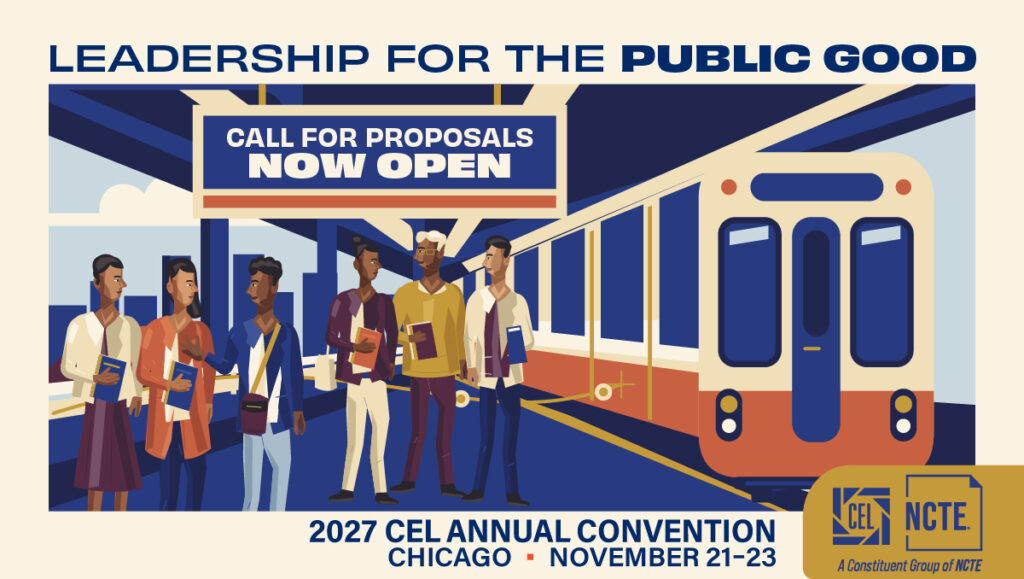
2027 CEL Annual Convention Call for Proposals
November 21–23, 2027 | Chicago, IL
Leadership for the Public Good
The deadline for proposal submissions is 9:00 a.m. ET, Tuesday, March 23, 2027.
Proposal notifications will be sent by the end of May 2027.
Proposal Coaching: Would you want a second set of eyes on your proposal before you submit? Whether you’re looking for assistance in aligning your proposal to the call and theme or if you’re a first-time submitter/presenter, we have volunteer coaches who can help. Email NCTEevents@ncte.org by Monday, February 1, to request a proposal coach.
See this collection of proposal mentor texts providing models for first-time (or returning) presenters on how to design successful proposals.
Educational leaders, including teacher leaders, have long seen defining the purpose of education as a key role of their work. Crafting, revising, and debating the big questions of education has happened in townhalls, school board meetings, the hallways of local schools, and in one-on-one conversations with neighbors. Legendary educator and former Chicago Teacher Union president Karen Lewis frequently articulated a purpose of education that was enmeshed with concerns of civic life and human flourishing. As a leader and organizer, Lewis modelled how educators could prompt the public to engage with the role schools play in society. Where and how educators engage with these larger questions of purpose may have changed, but the big questions endure, especially in our field: Who and what is literacy and English education for in today’s world? Our meeting in Chicago is driven by this spirit of talking, debating, engaging, pushing, and articulating what English and literacy leaders lead for.
These questions are urgent as educators find themselves in a moment of tumult and unease: escalating book bans and curricular gag orders dampen intellectual freedom, the threats and realities of funding cuts deny adequate resources to schools, the consequences of unregulated technology impact adolescents’ minds in intended and unintended ways, the attacks on immigrant students and their communities hinder access to education, and a slew of other mounting pressures are being exerted on schools. Managing these issues (and more) can leave little time to consider questions of purpose and scope. Ye these issues are in some ways shaping collective ideas of what schools are and who they serve.
Literacy and English educators have spent the last decade grappling with questions of broader civic purpose—calling on English education to act as “democratic armor” (Gatti et al., 2018, p. 118), making a case for teaching “civically engaged literacy” (Mirra et al., 2022, p. 5), and calling for educators to prepare youth for a “climate-changing world” (Tang et al., 2026, p. 17) to name three examples. Moving literacy and English education toward these visions requires various leaders to articulate a purpose for education and build capacity to fulfill that purpose. Literacy leaders are articulating, building, and leading in classrooms, districts, and leadership offices across the map.
In that spirit, the Conference on English Leadership seeks to amplify how English and literacy leaders are building a better public life in their work in both big and small ways. We seek proposal topics for our annual convention that center PK–12 schools, teacher education and ongoing professional learning, leadership development, instructional coaching, and/or community engagement and advocacy. Additionally, we are interested in proposals that offer a research-based practice that can be shared with attendees, advance a conversation relating to major ideas in literacy leadership, or invite participants to think through a complicated tension or topic relevant to the field. Proposals that are interactive and provide attendees with ideas they can bring back to their contexts will be prioritized. To echo the conference theme, Leadership for the Public Good, we encourage proposal writers to situate their work for the public good: How does the proposed material advance a better public life for our schools, communities, families, educators, and students? Proposal writers can think of the public good on the macro, structural level as well as on the micro, personal level.
This Convention invites 60-minute individual or group workshops on this year’s theme. Consider the following questions as potential guidelines for crafting your proposal:
- How are school leaders providing welcoming, inclusive schools and departments in this socio-political climate?
- How can we think of ELA and literacy classes as spaces for promoting civic engagement and public life?
- How do leaders support educators teaching honest, diverse curriculum in politically tumultuous times?
- How can community advocates, leaders, and organizers inform the way literacy leaders think about schools, education, and teaching?
- How can literary works and other texts associated with ELA help us think about public life and move toward action?
- How are schools building leadership teams that reflect the diversity of their communities, state, and the country at-large?
- What stories of success can be shared to inform how other leaders take action in their contexts?
- How are leaders sustaining and maintaining work that promotes inclusive, welcoming schools?
- What ways have professional learning and development work created more inclusive, welcoming schools, English classrooms, or literacy programs?
- How are leaders working with students, communities, and families to educate for the public good?
We also welcome 30-minute participatory roundtable conversations for this conference. These conversations are meant to prompt discussion and build relationships across the various contexts in which CEL attendees serve. Presenters will share their work twice during the allotted session as other attendees rotate among the tables. Roundtable proposals should advance community building and help participants draw connections between their work and other attendees. Consider the following ideas as starting points for roundtable sessions:
- Roundtable for Dialogue and Debate: Foster conversation about a complicated issue our field faces using thoughtful prompts, reflective tools, and guided questions.
- Roundtable for Making Art: Express yourself by making poetry, murals, sketches, music, or any other type of art that prompts reflection about our role as educators and civic actors.
- Roundtable for Reading the Word and the World: Make meaning together by reading and discussing a poem, short story, article or any other text that can incite dialogue.
- Roundtable for Civic Participation: Share how participants can get involved with their local communities and civic institutions through letter-writing, meeting with elected officials, building community action groups, and/or any other way you’ve found success in participating in civic life.
- A roundtable for anything else you can dream up!
Please do not feel the need to tailor participatory roundtable proposals strictly to literacy leadership work. We want to provide spaces for participants to share and connect outside of traditional hour-long sessions. These shorter sessions will provide us with dedicated time in the conference to foster relationships and build connections.
Proposals should aim to share information, research, and/or findings through a collaborative and/or interactive format. We are not seeking research presentations or reading of papers, however.
Henry (Cody) Miller
2027 CEL Annual Convention Program Chair
Submit a Proposal
IMPORTANT DATES
- Proposal database is open.
- Proposal coaching deadline: Monday, February 1
- Proposal submission deadline: 9:00 a.m. ET on Tuesday, March 23, 2027
- Proposal notifications: by the end of May 2027
- Registration & housing information available: Summer 2027
- Convention dates & location: November 21–23, 2027, Chicago, IL
NOTE: As a nonprofit organization of educators, we are not able to provide a stipend or reimburse expenses to presenters. All presenters must register for the CEL Annual Convention.
References
Gatti, L., Masterson, J., Brooke, R., Shah, R.W., & Thomas, S. (2018). English education as democratic armor: Responding programmatically to our political work. English Teaching: Practice & Critique, 17(2), 116–131.
Mirra, N., Eckert, K., French, S., & Timmons-Long, L. (2022). Reading, writing, & raising voices: The centrality of literacy to civic education. National Council of Teachers of English.
Tang, J.K., Fisher, L., Diaz, O., Jane, D., Kleese, N., & Onishi, Y. (2026). The hand we’ve been dealt: Critical pedagogy and reciprocal K–12 university partnerships. English Leadership Quarterly, 48(2), 16–21.