By: Carolyn Calhoon Dillahunt, Doug Hesse, Sharon Mitchler, and Howard Tinberg
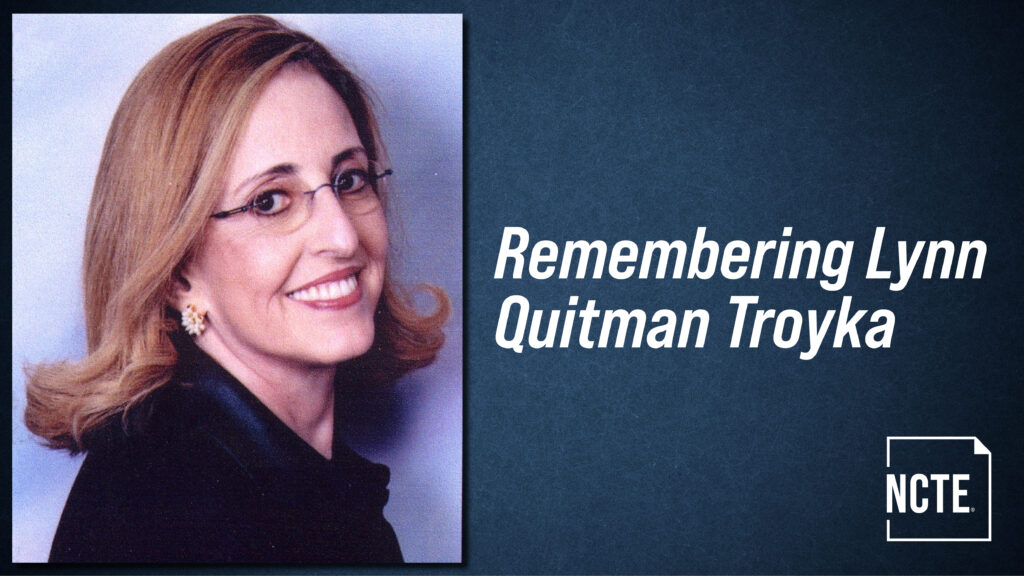
We celebrate the legacy of Lynn Quitman Troyka, a towering figure in the Two-Year College English Association (TYCA), the Conference on College Composition and Communication (CCCC), NCTE, and the teaching of writing, and winner of both the 2001 CCCC Exemplar Award and the 1995 TYCA Nell Ann Pickett Award. We only recently learned of her passing a year ago (September 11, 2024) and honor her now. Lynn spent her teaching career at the City University of New York, most of those years at Queensborough Community College. She was one of the first two-year college professors elected Chair of the CCCC (1981) and was instrumental in founding TYCA, serving as its first elected Chair (1997); both organizations recognized her efforts with their top honors. She edited the Journal of Basic Writing and published in College English, College Composition and Communication, Writing Program Administration, and numerous other journals and books. (For insights on Lynn’s work, see Lynn Reid’s chapter in Lost Texts in Composition, “Lingering Questions from Lynn Quitman Troyka’s ‘Defining Basic Writing in Context’.”) Her Simon and Schuster Handbook for Writers and Quick Access for Writers (among Lynn’s dozen books) helped hundreds of thousands of students. She served in countless other professional roles, chairing the MLA Division on Teaching Writing, the NCTE College Section, the CCCC Mentoring Committee, and the Task Force for the Future of CCCC, to name just a few. Above all these, she was dedicated to her students and generous to her colleagues.
Lynn Troyka always said yes and always showed up.
Carolyn remembers: “I met TYCA and Lynn Troyka at the same time, attending the 2001 TYCA-PNW Conference at Centralia Community College. Lynn was the keynote speaker, a perfect choice, given her scholarly work and two-year college leadership, though, at the time, I had no idea how significant Lynn was in the formation of National TYCA, nor what a place National TYCA would come to hold in my own professional journey. I recall talking to Lynn after her presentation, a bit awestruck about meeting someone whose scholarship I knew so well from my graduate work. From the first time I met her, Lynn was gracious and encouraging, and to my surprise and appreciation, she kept in touch with me, a newbie to the profession and the organization. She encouraged my engagement and celebrated my involvement with TYCA and, later, CCCC leadership. She was always so pleased and proud of two-year college faculty being recognized within the larger profession! She also invited me into professional activities, including co-presenting Basic Writing on TYCA-related panels, connecting me with other BW and two-year college colleagues, and, later, assisting with revisions of chapters in her Quick Access textbook. Even though I was a very junior scholar, Lynn respected my perspectives, offered candid feedback and advice, and always recognized my and other two-year college faculty’s accomplishments. I remember her for being professionally active throughout her long and illustrious career and especially for being a fixture at TYCA events, delighting in and cheering on the next generation of two-year college leaders and scholars.”
Doug remembers: “In 1980, Washington, DC, I first met Lynn. I was a callow master’s student attending my first convention of any sort, and I’d stumbled into the CCCC open general session, where she spoke as Program Chair. Over the next two decades, I was impressed by her tireless advocacy of first-year writers. So when she contacted me to help with revisions of the Simon and Schuster Handbook for Writers, I was surprised and humbled. I learned so many things as her coauthor. Foremost was her focus on students. I’d write something “cutting edge,” and Lynn would reply with pointed edits, crossing out whole sentences and paragraphs with notes like, ‘This won’t help them!’ She was inevitably right. I admired her blunt tenacity in negotiations with publishers, frequently telling them, ‘This is wrong!’ or just plain, ‘No!’ I think she’d approve of my characterizing her, with respect and affection, as a “tough broad” in the best New York sense of the term. She loved her husband, David, deeply, cared passionately about human and animal rights, and traveled the world with exuberance.”
Sharon remembers: “Lynn was noted for stepping up to help TYCA members, even when it was not simple or easy to do so. For example, when I set up the TYCA-PNW Conference in 2001, I sent a furtive email to Lynn. I had met her only once at TYCA events at the CCCCs conference in 2000 and did not expect she would remember me or have room in her calendar to join us. She answered immediately and offered to fly all the way across the country and serve as our keynote speaker. That’s the Lynn I remember best—always there when you sent out a call for help. We had no money for the conference, so her publisher sponsored her visit, though I always wondered if she also supported some of that trip financially herself. She was inspirational, of course, and she helped to kick off our regional rebirth.”
Howard remembers: “As many are noting in their tributes, Lynn would go out of her way to support and encourage colleagues, especially those of us committed to building careers at the community college. I was one of those lucky many who became a beneficiary of ‘Lynn’s Stamp of Approval.’ The year: 1997. The place/occasion: CCCCs in Phoenix. At the opening session, Lynn addressed the Convention as the very first Chair of TYCA. She, of course, was the perfect choice to be TYCA’s first Chair and to represent the organization at our discipline’s annual conference: she had the star power and, I should add, the New York chutzpah to speak for us and to make us all proud. Well, there I was listening attentively as she made the case for how important the literacy work we were doing at the community college was, when she raised a book for the crowd to see and said (or something to the effect), ‘Go buy this book. It’s a good one. And it’s written by one of us, a two-year college faculty member. This is what we are capable of producing.’ That book was Border Talk: Writing and Knowing in the Two-Year College, my very first book, which had the good fortune of being published right before the Phoenix Convention. I was stunned and so very, very grateful for that recognition. I felt that I belonged. There was no better feeling.”