By: Kelly (Kel) Sassi, president-elect, Michigan Council of Teachers of English
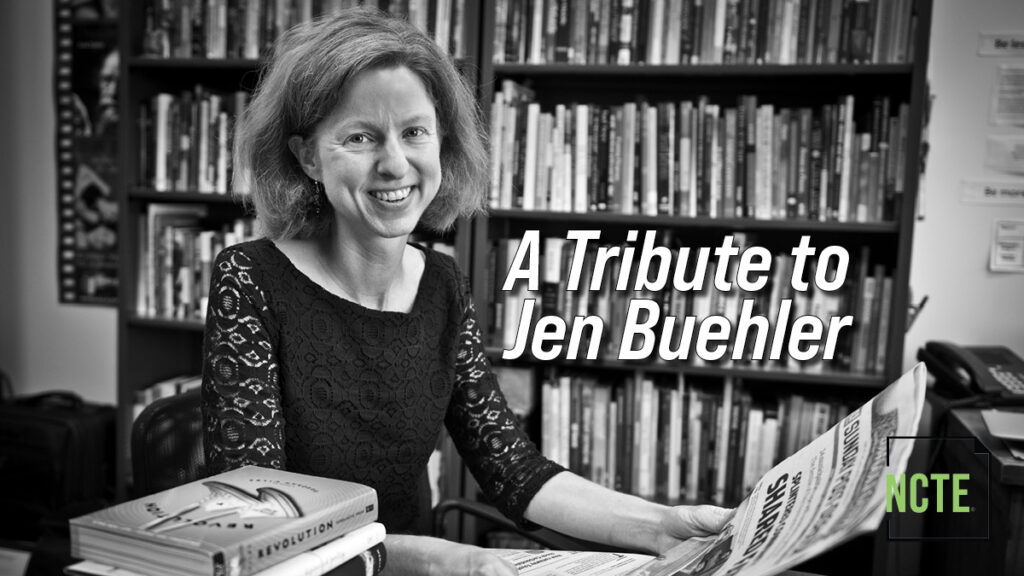
For many of us in the NCTE community, it is unimaginable that we won’t be seeing Jennifer Buehler at our Annual Convention in Philadelphia this November. She had a way of greeting you as if you were the one person she was hoping to run into and as if the year between Conventions was just a momentary pause in an ongoing vibrant conversation. A member of NCTE for more than 27 years, she served as president of the Assembly on Literature for Adolescents of NCTE (ALAN) in 2016 and was an active member of ALAN for many years. After receiving the NCTE Promising Researcher Award (2011), she went on to write for NCTE journals, the Literacy & NCTE blog, and NCTE’s Council Chronicle magazine. Jen wrote one of NCTE’s most popular Principles in Practice books, Teaching Reading with YA Literature: Complex Texts, Complex Lives.
A conversation with Jen was likely to include knowledgeable and enthusiastic words about the latest book she had read by a new author of young adult literature (YAL). Many of the tributes written by friends and colleagues since her tragic, untimely death include a story of how she turned them on to the wide world of YAL. I met Jen in 2003, when we were both starting our doctoral work in the Joint Program of English and Education at the University of Michigan. We bonded over navigating our studies while nurturing our preschool-aged sons. Although parenting and studying consumed me, I couldn’t resist some secret, pleasurable reading of the YA novels Jen recommended and became a fan of the podcasts she created for NCTE called Text Messages: Recommendations for Teen Readers. As English teachers, it is easy for us to recommend the books that we enjoy to our students, but far more challenging to be familiar enough with YA books to match the just-right book with the student who needs to read it. Listening to Jen’s thoughtful, themed curation of YA texts (e.g., fairytale retellings, sports stories, graphic novels) helps us expand our repertoire. At the 25th anniversary of 9/11, her episode “The Post 9/11 Landscape” is useful once again for learning about books dealing with 9/11 and the wars around the world since then.
Jen didn’t just advocate for YAL person-by-person. She was an inaugural and very active member of the Build Your Stack Committee, an important component of the NCTE’s Build Your Stack initiative that launched in 2018. She was a significant contributor to NCTE’s ReadWriteThink.org, ranging from lesson plans to the aforementioned podcasts. She served on the ALAN Board of Directors and many ALAN governance committees as well. In June 2017, her YAL book was the focus of NCTE’s inaugural NCTE Reads book club, a month-long guided discussion.
Her contributions were recognized at the 2025 NCTE Annual Convention, where she was the recipient of ALAN’s Ted Hipple Service Award. As I listened to Jen’s inspiring speech, I covertly moved into position to capture photos of her to send to her husband, Mark, and son, Ethan, who I knew would be so proud of her. Mark said, “I lobbied hard to put the one photo on the left (clearly indicating the award) into our holiday newsletter. Nope! Jennifer was apoplectic. It was like an allergic reaction. She had such a strong visceral reaction to the notion of tooting her own horn, even in a subtle way. I sincerely tried, I really did.” Jen’s humility was one of the reasons she was so effective as an advocate for YAL, as a teacher, as a leader, and as a mentor. She never let ego get in the way of furthering the cause. At the heart of her YA advocacy was a genuine respect for teens, all teens. In an article entitled “Standing Up for YA Literature,” Jen wrote, “Students are trying to become adults and find their place in the world. That is a struggle that should be honored, not, as our culture often does, dismissed or ridiculed.” This deep respect she held for teens also applied to YA authors; I have overheard some of her conversations with them at Convention, demonstrating care and kindness for their sacred work.
As my grad school colleagues and I mourn her loss, our stories are often about her grace and her mentorship. Christian Dallavis wrote, “She taught me to be an ethnographer; she helped me improve my writing; she showed me how to ask good questions; she modeled dogged persistence for a research question for me; I still teach school culture today because Jen sparked my interest in it with her dissertation.” Jen was a magnet, drawing us to NCTE, to ALAN, to the National Writing Project. Her colleagues from the Eastern Michigan Writing Project, Jen Walsh and Sarah Andrews, both noted how she ignited their passion for YAL.
This passion will burn on. Alongside mourning our personal loss, we also mourn our collective loss—she was working on a book about Judy Blume, among other projects. Her infectious enthusiasm and collaborative approach to her work has ensured that she leaves behind an enormous cadre of students, colleagues, mentees, and friends who will continue to champion the cause of literacy, teen readers, intellectual freedom, and young adult literature.