Access the 2026 Achievement Awards in Writing prompt now, and sign up here to get an email reminder when the contest opens on October 20, NCTE’s National Day on Writing.
In 2024 and 2025, for the first time since the NCTE Achievement Awards in Writing opened to tenth-graders, three contest participants took top honors for two years in a row—with each winning First Class in both grades 10 and 11.
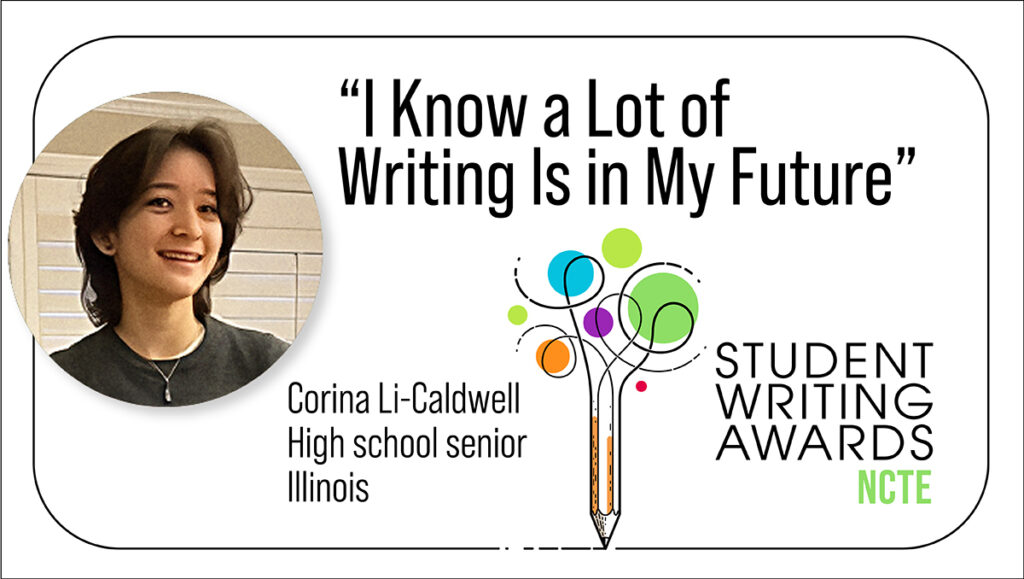
NCTE is highlighting the achievements and education experiences of these students in a blog post series. This post features the writings and reflections of Corina Li-Caldwell, a senior at Evanston Township High School in Illinois.
In her eleventh-grade submission, Corina wrote:
“As I finished the book, I gazed out into my room, and for one moment, I wasn’t terrified of my future. It felt as though an existential weight had been lifted from my shoulders. … I wasn’t sure if the future would be recognizable to our world today, but my unwavering belief that the world would surely end in some awful manner was shaken.”
NCTE: In both 2024 and 2025, the prompts for the Achievement Awards in Writing asked you to write about yourselves to some extent, and the pieces you wrote for both years connected to your identity. How do you approach personal writing, especially knowing that it is being read by others and considered for publication?
CL: I know that for a lot of students my age, or students in general, personal essays are often considered a drag, or embarrassing. And in some ways, I totally understand. Personal essays demand both vulnerability and deep introspection; to turn that kind work over to an English teacher who you may or may not know that well is scary.
I feel like we live in an age where empathy is far less common than it should be. For me, personal essays are my primary tool in communicating either a greater truth about myself, or what I believe to be a greater truth about my generation to others—to generate empathy between generations or between people of different races and perspectives. When I get ready to submit my piece, I worry less about who will be reading it and more about whether I feel satisfied with my pacing, metaphors, and themes. I feel like if I can workshop those skills enough, it shouldn’t matter as much who is reading my essay.
NCTE: What would you like younger students to know about writing? Is there any writing advice you wish you could give your younger self?
CL: I would tell younger students that if they are unhappy with the way they write, they should read authors with writing styles that they enjoy and try to pick apart what exactly goes into the construction of passages and themes word by word. Writing is not nearly as much of a “talent” as most people think.
I wish I could tell my younger self to not give up on so many incomplete ideas. As a younger writer, I had a bad habit of abandoning stories because they didn’t sound the same or evoke the same emotion as I had initially imagined. For me, endings and transitions have always been hard, so I’d have to tell myself to push through instead of giving up on an idea before I’ve even reached the second draft. You could have hundreds of perfect beginnings, but they are not worth the same as one complete story.
NCTE: How has being recognized by the National Council of Teachers of English for the Achievement Awards in Writing affected your mentality as a writer and student?
CL: I’ve always been an anxious person, and, in turn, a perfectionist, particularly with writing. For both essays I’ve submitted to NCTE, I haven’t been completely happy with my final product. Being recognized by NCTE has given me some hope that people are willing to listen to my thoughts and experiences, and that they find my reflections moving as well. This whole experience has definitely taught me to have more confidence in my final products.
NCTE: How have your teachers supported you in your writing journey?
CL: My teachers have always made me feel like my ideas are worth pursuing. For example, I pitched short story plots that were exceedingly complex; they challenged me to refine my idea until my story was briefer but still conveyed my original idea. Or, when I wrote niche research paper proposals, they helped me find sources by teaching me how to properly search databases.
NCTE: How has your experience in your ELA/writing classes inspired you, whether in terms of writing style, inspiration from teachers or readings, or simply gaining confidence through feedback from classmates or teachers?
CL: My writing classes, particularly the ones I’ve had in high school, have done wonders for my writing style. As we focus on reading books more deeply, and discussing authors’ tools in terms of rhetorical choices, I find myself absorbing more and more tools from the writers that I admire or altering certain concepts to use for my own.
NCTE: As a rising senior, what are your goals for the future in terms of education and career? What role does writing play in them?
CL: I’ve been working on my college applications, and am hoping to head to a liberal arts college, majoring in the humanities. So, of course, writing many, many essays is a part of my near future. But beyond that, I would like to continue practicing writing as an art form and utilizing it as a tool.
I aspire to become a lawyer, either working in international law or working for the legal side of nonprofits. Either way, I know a lot of writing is in my future, and I am happy to continue honing my skills of both persuasion and artistry.
Corina Li-Caldwell is a senior at Evanston Township High School in Evanston, Illinois. Her passions are reading, creative writing, and music. She plays piano and violin and helped organize a program to provide elementary students with free after-school music tutoring. Her happy place is a cottage in Northern Wisconsin, where the snows are deep and she can walk across a frozen lake with her friends. In summer 2025 she attended a six-week language and cultural immersion program in Hsin Chu, Taiwan.
It is the policy of NCTE in all publications, including the Literacy & NCTE blog, to provide a forum for the open discussion of ideas concerning the content and the teaching of English and the language arts. Publicity accorded to any particular point of view does not imply endorsement by the Executive Committee, the Board of Directors, the staff, or the membership at large, except in announcements of policy, where such endorsement is clearly specified.