Access the 2026 Achievement Awards in Writing prompt now, and sign up here to get an email reminder when the contest opens in mid-October.
Read part one of this series.
In 2024 and 2025, for the first time since the NCTE Achievement Awards in Writing opened to tenth-graders, three contest participants took top honors for two years in a row—with each winning First Class in both grades 10 and 11.
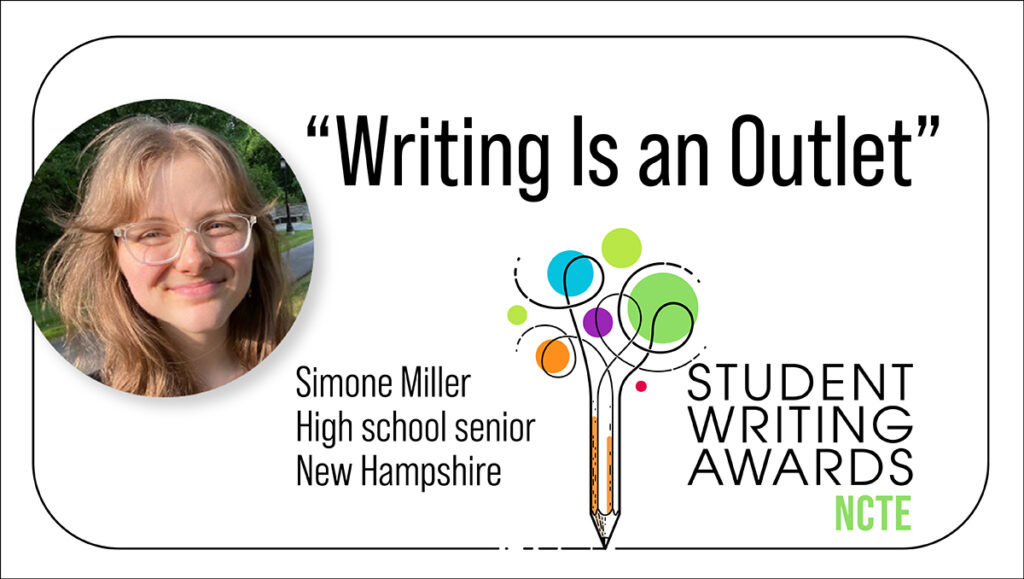
NCTE is highlighting the achievements and education experiences of these students in a blog post series. This post features the writings and reflections of Simone Miller, a senior at Londonderry High School in New Hampshire.
In her eleventh-grade submission, Simone wrote:
“instead,
the words set anchor.
Alvarez sat on the ocean floor with me
and did not run away
she talked to me in my mother tongue
of twisting tales, one that
I believed I was the only speaker of.”
NCTE: What would you like younger students to know about writing? Is there any writing advice you wish you could give your younger self?
SM: If I were to sit down and chat with younger students, I would want them to know that writing is always personal. It’s never just a “five-paragraph thesis paper due tomorrow night.” In everything you write, there is a little seed of yourself; this is the greatest strength of any artwork.
At first, I didn’t realize that I turned my Google documents into gardens of my own ruminations. When I began to see my tendencies to do this, I tried to purge my writing of any personal influences. I believed that a literary analysis essay about The Awakening by Kate Chopin for English class must be strictly about the book and nothing about my own interpretation. With time, I learned to embrace my way of processing feelings by masquerading them behind double-spaced sentences. It fortified my voice. I would advise writers of all ages to lovingly incorporate their voice into the writing process, even if it is cleverly hidden behind a Times New Roman façade.
NCTE: What does writing mean to you?
SM: To me, writing is an outlet. Whether it’s spontaneous chicken-scratching into a notebook long after dark or a blank digital document with a blinking cursor, I find a sense of relief in putting my feelings into words. I love stringing letters together like a friendship bracelet into poems and analogies.
Sometimes, I look back on pieces that I wrote years ago and imagine them as time capsules recording what I was experiencing. It used to be easier for me to create a cohesive metaphor that connects feelings of isolation to the ocean. It was difficult to voice the three words of “I feel alone.” I explored this in “Monolingual in Metaphor,” my 2025 submission about how I found solace in How the García Girls Lost Their Accents by Julia Alvarez.
Other times, I find that I write to plan. However, it isn’t a traditional to-do list: while writing “A Planet’s Guide to Escaping Orbit,” my 2024 submission, I was unknowingly charting a roadmap for a journey of self-growth that I had just begun.
NCTE: How has being recognized by the National Council of Teachers of English for the Achievement Awards in Writing affected your mentality as a writer and student?
SM: Since being recognized by NCTE, many negative beliefs of mine have been dissolved. I thought that my voice would never fit the cookie-cutter response that I perceived the judges to be looking for. After the contest results were announced, it finally sunk in that a submission with an author’s unique voice is worth more than any carefully curated essay that lacks personality. I learned to bring this mindset to my studies and my writing, experimenting with different forms of creativity to express my true perspective.
NCTE: How have your teachers supported you in your writing journey?
SM: If my sophomore-year teacher hadn’t pushed me to apply for the NCTE competition, I doubt that I would have had the guts to submit work. I am grateful for the support and feedback that all my teachers have given me over the years. They challenge me with feedback on my blind spots as an author, flagging them with colorful ink. Additionally, if not for their out-of-the-box lesson plans, I would have never tested out new writing styles. My vignette about the origins of my name or a Shakespearean sonnet featuring current news headlines would remain mere ideas.
NCTE: As a senior, what are your goals for the future in terms of education and career? What role does writing play in them?
SM: In the future, I plan to pursue higher education and enter the medical field. I aspire to become a surgeon or emergency department physician. As a medical professional, I would use my writing skills to approach challenging conversations and reports with patients in a sensitive and kind manner.
Additionally, I would continue to engage in personal writing; I am always reflecting on ways that I can improve not just in my career, but in my duty to serve humanity. Each piece I write is a ladder rung toward who I am working to become. My experiences with NCTE and high school English classes prompted me to critically examine my own perception of the world. I learned to look beyond my own two feet and see life through the eyes of another. As a result, I am equipped to approach my future career as a leader that promotes fair and equitable healthcare.
Simone Miller lives in Londonderry, NH, with her parents, sister, and three cats. In her free time, Simone practices for color guard, jots down poetry, and ranks the oatmeal from local diners.
It is the policy of NCTE in all publications, including the Literacy & NCTE blog, to provide a forum for the open discussion of ideas concerning the content and the teaching of English and the language arts. Publicity accorded to any particular point of view does not imply endorsement by the Executive Committee, the Board of Directors, the staff, or the membership at large, except in announcements of policy, where such endorsement is clearly specified.