Access the 2026 Achievement Awards in Writing prompt now, and sign up here to get an email reminder when the contest opens in mid-October.
Read part one and part two of this series.
In 2024 and 2025, for the first time since the NCTE Achievement Awards in Writing opened to tenth-graders, three contest participants took top honors for two years in a row—with each winning First Class in both grades 10 and 11.
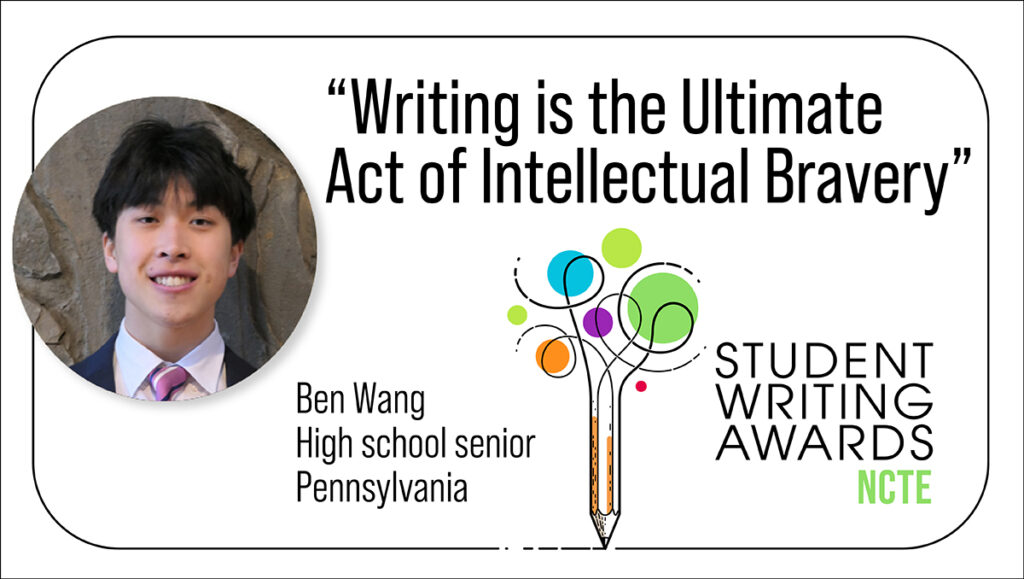
NCTE is highlighting the achievements and education experiences of these students in a blog post series. This post features the writings and reflections of Ben Wang, a senior at Council Rock High School South in Pennsylvania.
In his eleventh-grade submission, Ben wrote:
“Minor Feelings found the sole spark still flickering around in the deepest recesses of my mind, buried beneath mountains of Twisted Teas and shame, and set it ablaze. Her stories are not mine, but they felt close enough to trigger an unsettling feeling. I did not want to admit how I had spent years violently scrubbing away the Asian parts of me, desperate not to stand out. But page after page, Hong’s words relentlessly chipped away at the walls I had built, dismantling every poorly made excuse and justification until my whole psyche was left dissected and exposed.”
NCTE: In both 2024 and 2025, the prompts for the Achievement Awards in Writing asked you to write about yourselves to some extent, and the pieces you wrote for both years connected to your identity. How do you approach personal writing, especially knowing that it is being read by others and considered for publication?
BW: When I approach personal writing, the only viewpoint I ever consider at the moment is my own. I found a long time ago that attempting to contort my narrative to satisfy the nuances of a mentor, or my writing to fit the molded format of a literary example hinders not only my own story, but it stifles my progression as a writer.
Ultimately, my writing, in its messiness and magnificence, is my own primary audience. I find it serves as a conduit for a deeper emotional and mental connection to my own experiences and past actions. It is this commitment to authenticity that I believe creates a palpable connection to my audience.
I don’t shy away from any details or attempt to push them down, trying to bury them under layers of emotional baggage. Writing is the ultimate act of intellectual bravery: laying bare every detail, confronting them on paper, and therefore, confronting them within myself.
NCTE: What does writing mean to you?
BW: Writing is a medium of expression, a tool for education, but in my heart, it’s the closest humanity can get to long-range telepathy. We will never be able to fully understand another person, but being able to bottle the chaos of one person’s thoughts and ship it to another’s mind lets us argue with the past, talk to the future, and even understand the present. It’s our memory, our conscience, and the proof for every civilization that ever lived, that we were here.
NCTE: How has being recognized by NCTE for the Achievement Awards in Writing affected your mentality as a writer and student?
BW: I am incredibly honored to be given the chance to be recognized and even the opportunity to participate in the NCTE Achievement Awards in Writing. I am fortunate enough to come from not only a public school district that supports the program, but from a household that can afford a laptop, and the luxurious gift of free time to spend chasing ideas.
Before this, my writing goals were never concrete and were often nebulous things, like finishing a story before I got bored with it or writing something cool. The NCTE award has given me a tangible aim and an achievement to pursue. Each piece I submitted was the culmination of weeks of work in writing and revising, and I knew that it should hold a special meaning for myself. Never had I written anything this long, and while it seemed daunting, it gave me the chance to prove my own dedication. It wasn’t just about being a “student” who has to write and a “writer” who likes to write anymore. It was about fusing those identities, proving to myself that I could juggle the analytical with the creative and come out on the other side with something I was genuinely proud of. It gave my writing a purpose beyond my own head, and for that, I am ridiculously thankful.
NCTE: How have your teachers supported you in your writing journey?
BW: No writer is entirely self-made, but instead is the culmination of thousands upon thousands of tiny influences from teachers and life experiences, until they combine into a new identity entirely. My ability to write would never have been possible without the help of my teachers in both my sophomore and junior years, Mrs. Holloran and Mrs. Sharp.
Many afternoons after the last bell, I sat in their classrooms, rambling about what I was attempting to convey, while they passionately listened. They were editors and collaborators and helped me understand the obstacles.
Even back to Mrs. Gainsley, who praised my first—albeit slightly plagiarized—novel about a very specific spider that climbed up a pipe. Even when the fuel was borrowed, she saw a spark and helped me realize it.
NCTE: How has your experience in your ELA/writing classes inspired you, whether in terms of writing style, inspiration from teachers or readings, or simply gaining confidence through feedback from classmates or teachers?
BW: The best English classes are the ones that emphasize not just tedious literary analysis and discussion but also foster a collaborative environment. I am naturally selective about who I let read my writings while they are still in the process of being written, but the feedback and encouragement I have received from those who I did show them to have always been immeasurably valuable.
Benjamin Wang is a senior at Council Rock High School South, where he spends most of his time finding creative ways to procrastinate on college applications. Splitting his days between work and writing, he often tries to find peace in playing golf or three-on-three basketball and by browsing for new clothes. Writing has always been his favorite way to express himself, and he hopes to one day publish a collection of short stories.
It is the policy of NCTE in all publications, including the Literacy & NCTE blog, to provide a forum for the open discussion of ideas concerning the content and the teaching of English and the language arts. Publicity accorded to any particular point of view does not imply endorsement by the Executive Committee, the Board of Directors, the staff, or the membership at large, except in announcements of policy, where such endorsement is clearly specified.