
By: Kristie Camp, NCTE member and 2024 NCTE Teacher Research Grant recipient
Apply now for an NCTE Teacher Research Grant.
Does this scenario sound familiar?
You have been watching your students and taking notes during the past few lessons. You identify an area where they need to grow, and you try out some strategies. You make note of what seems to work and endeavor to discover why.
If you find yourself in this situation, then now is an excellent time to apply for the NCTE Teacher Research Grant.
My research partner Heather White and I were honored to receive a 2024 NCTE Teacher Research Grant. It partially funded my dissertation study that examined student writing during a series of outdoor literacy events. Applying for the grant, managing the funds, and sharing the results proved to be a valuable professional learning experience that I recommend to any teacher who is serious about engaging in authentic action research.
For more than 20 years, Heather and I taught secondary English language arts in adjacent classrooms at Gaffney High School in South Carolina. We often exchanged ideas and partnered on projects to enhance student engagement and discover meaningful and effective instructional strategies. We both periodically took students outside for lessons, and we both believed in the value of outdoor literacy events.
When I decided to study outdoor education formally, Heather was ready to team up. That is what brought us to the NCTE Teacher Research Grant. We wanted the opportunity to share with other ELA professionals what we had learned from working together because we knew those colleagues could deepen our thinking about the research and strengthen our pedagogy.
For our study, we designed a writing unit for one of Heather’s classes of English III students. Most of the students were boys, many of whom had been tracked together in this class because they had a history of failing grades, excessive absences, and/or discipline infractions. Our plan featured nine outdoor lessons, each of which consisted of three segments: a shared read-aloud, an action prompt requiring students to pursue a quest involving physical interaction with a wooded setting on campus, and an open-ended writing prompt that asked students to respond to their outdoor activity. Students could choose to respond in various modes, such as visual art, photography, vlogging, and writing in any genre.
We found that students who had not written anything so far in their ELA class enthusiastically embraced imaginative writing and active storytelling when given space to explore the outdoors and to choose their preferred mode of communication. Their creative responses afforded Heather a more thorough understanding of her students’ writing strengths than she had gained through a standardized instructional protocol.
This valuable discovery was made possible through the NCTE Teacher Research Grant, which funded some of the study materials and helped pay for our travel expenses for the 2024 NCTE Annual Convention in Boston. In addition, I learned so much about the research process through this experience: how to write a grant, how to manage the funds according to university requirements, and how to write about the research in real time as well as after analyzing our findings.
The process taught me to express the essence of my research quickly and coherently, as I needed to explain my purpose, process, and results clearly and concisely in writing and in conversation. The roundtable format through which we shared our findings at the Convention not only afforded me practice in sharing my ideas but also allowed me to meet other teacher researchers and hear about their projects. We asked each other questions about our research and shared discoveries we had made in the process, which allowed us to learn both effective instructional practices and new approaches to action research.
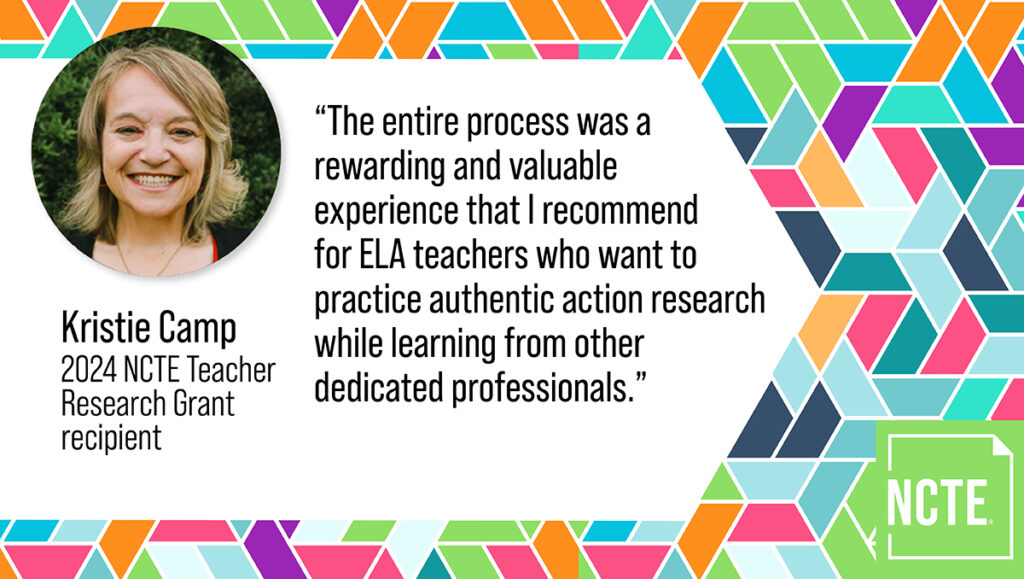
The entire process was a rewarding and valuable experience that I recommend for ELA teachers who want to practice authentic action research while learning from other dedicated professionals.
Kristie Camp is a retired National Board Certified Teacher who taught secondary ELA in South Carolina for 26 years, and now teaches freshman English classes at Spartanburg Methodist College. She earned a PhD in language and literacy from the University of South Carolina, and her area of research is adolescent literacy in the outdoor classroom.
It is the policy of NCTE in all publications, including the Literacy & NCTE blog, to provide a forum for the open discussion of ideas concerning the content and the teaching of English and the language arts. Publicity accorded to any particular point of view does not imply endorsement by the Executive Committee, the Board of Directors, the staff, or the membership at large, except in announcements of policy, where such endorsement is clearly specified.