
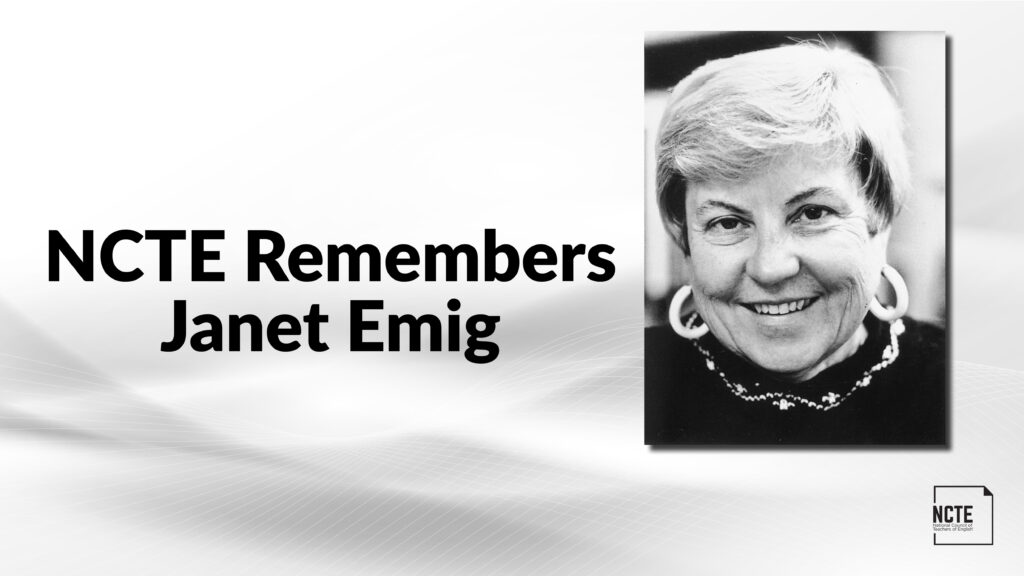
NCTE pays tribute to our past President Janet Emig, a pioneering scholar, passionate educator, and friend.
The professor emeritus at the Rutgers University Graduate School of Education led NCTE in 1988–89, after serving as Vice President in 1987–88.
“Janet Emig reshaped the field of English education, emphasizing that writing can be understood as a process grounded in cognition, experience, and humanity,” said NCTE President Antero Garcia (2025–26). “The legacies of her scholarship continue to guide how teachers, researchers, and students understand writing as a vital, life-shaping practice. Her ideas live on wherever writing is honored not just as a product, but as a way of thinking, learning, and becoming.”
Janet recently recalled how she was introduced to NCTE: The chair of the English department at her Wyoming high school suggested she attend the organization’s 1951 Annual Convention in Cincinnati.
“Thereafter, I think I attended almost every national meeting, whether it was held in Kansas City or Miami,” Janet wrote. “I found the experience extraordinary. Here was the best of our field gathered together yearly to exchange ideas and friendships. Friends I made at NCTE stayed friends for a lifetime.”
Janet was chair of the 1988 NCTE Annual Convention, where Maya Angelou led a memorable audience rendition of “Amazing Grace.”
The same department chair encouraged Janet to join the NCTE Children’s Poetry Awards Committee, and poetry remained one of her lifelong pursuits. Just three years ago, at the age of 94, Janet published her poetry collection, Dusk. Former NCTE President Valerie Kinloch (2021–22) wrote in the preface: “Dr. Emig’s approach to learning has impacted how I think about writing as a practice in communicating and communication, composing, discovery and rediscovery, storying, and expression.”
In 1971, former NCTE Executive Director James R. Squire—for whom the esteemed award and Office of Policy Research in English Language Arts are named—approved the publication of Janet’s doctoral dissertation as The Composing Processes of 12th Graders (NCTE Research Report, 13). The widely influential case study of eight Chicago-area students laid the foundations for the process theory of composition, which considers writing as a process, as opposed to a product.
“It was a landmark in composition studies, partly from its findings but mostly from her groundbreaking qualitative research approach,” said Doug Hesse, who was NCTE President in 2015–16. “It was one of THE books that folks in composition studies in the 1970s and 1980s needed to know.”
Janet’s pivotal essay “Writing as a Mode of Learning” was published in the NCTE journal College Composition and Communication in 1977. This work was foundational to the Writing Across the Curriculum (WAC) movement and is heavily anthologized, cited, and read to this day. In 1983, her book The Web of Meaning: Essays on Writing, Teaching, Learning, and Thinking was published and received the Modern Language Association’s Mina P. Shaughnessy Prize. She also received the Lifetime Achievement Award from the International Reading Association.
In fact, the NCTE constituency group now known as English Language Arts Teacher Educators named an award after Janet herself in 2000: the ELATE Janet Emig Award for Exemplary Scholarship in English Education. It recognizes the author of an exceptional article for excellence in scholarship and educational leadership published in English Education, the journal of the NCTE constituent group English Language Arts Teacher Educators (ELATE).
Janet passed peacefully in her home in Naples, Florida. She will be fondly remembered and deeply missed by the NCTE community.